As in Incident command...

IC established!
We'll have several different sections reporting in - recent research, local topics, or highlighting areas of the Sponsor Hospital Council of Greater Bridgeport protocols.

*** Keep in mind - this website does not replace your protocols, and these posts do not reflect SHCGB or Bridgeport Hospital policies. This is a place to discuss research, controversies, or discuss possible future protocols. When in doubt, check your current protocols through the official source.

Monday, January 13, 2014

Pediatric Anaphylaxis: Medication errors by EMS

You are called for a 5-year-old child with trouble breathing. 

The mother states the child has had 1 hour of progressive respiratory distress after being stung by a bee. The initial vitals are BP 76/40, P 120, R 45, and SpO 91% on room air. The patient is sitting upright, speaking in short sentences, and has audible wheezing. The physical exam reveals hives over the chest and arms.  If you don't act in 2 minutes, your patient will decompensate. What do you do?

(By the way, this is a HIPAA-compliant picture of your patient:)


Yup, it’s a replicant, and just like Roy Batty, he was programmed to die in this EMS simulation study performed in Michigan. 

Unlike Roy Batty, however, this replicant will live if he is given epinephrine in time!

"I've seen things you people wouldn't believe...  And I need some epi!"

The authors used a high-fidelity simulation manikin, in a well-equipped simulation center, as well as the scenario described above. They allowed the EMS crews to use their own medication and equipment, but they all had to follow the state EMS protocol for pediatric anaphylaxis. 

Michigan EMS protocols
 If the crews gave the right medications and interventions, the kid got better. If not....

So what happened? 

Before I answer that, let me point out that the EMTs and medics volunteered for this study. This suggests that these folks were motivated enough to participate in research, aware they were going to observed, and fairly confidant in their knowledge and skills. In other words, probably some good, smart people.

So, it's all the more distressing what the study found.

1. Three out of 62 crews (5%) did not give epi 
For true anaphylaxis, epinephrine is the required treatment, with essentially no contraindications. 


2. Epi was often given by the wrong route. 
The protocol spelled out that epinephrine should be given IM, in line with several national and international guidelines. Despite this, only 37 out of 59 (63%) crews gave epinephrine IM. The authors were generous, and allowed SQ as an acceptable route, but this is an outdated practice. 

3. An epi dose of > 1 mg was given by 20% of crews. 
‘Nuff said about that... 

4. Epi was given intravenously by 15% of crews 
Although IV epi is listed in the protocol, even "low" doses of IV bolus epi can cause badness. With that in mind, the protocol allowed for IV epinephrine only “in cases of profound anaphylactic shock (near cardiac arrest).” 

Because the patient was initially sitting upright, speaking, and perfusing, IV epi was considered a major error.

5. Less than half of the crews gave epi by the right dose and route. 
As shown in this table:


So why did this happen?
It's hard to manage a rare medical event, using a drug that is available in multiple concentrations, and can be given by multiple routes, but must be dosed accurately by weight.

And as I said before, these were engaged and motivated EMS providers. Furthermore, the errors that they committed have been demonstrated to occur in a number of prior studies and case reports, involving a wide range of medical personnel.

In other words, you can’t respond to this study by saying “Well, our guys would never screw up like this!” Or by saying “We’ve been doing it this way for years without a problem.” This study should force all of us to reevaluate how we teach, protocolize, and practice treatment of anaphylaxis.

If you have the patience, download the author’s summary (the picture below) of the types of errors that were committed, and the rationale of the medics who committed them. Very informative!


Friday, January 3, 2014

The Cardiac Save Pin

I’ll admit, I don’t understand why the stork pin is so popular. 

The mother is doing all the pushing and tearing, while the medic or EMT isn’t really doing any work besides not dropping the newborn. That’s not really an advanced medical skill, you have to admit.
"Good job holding a human off the floor!"
Our new “Cardiac Save” lapel pin, on the other hand, recognizes the judgement that medics use in identifying a STEMI, and then communicating effectively with the ED and cardiology. These skills aren’t as dramatic as, say, sinking an ET tube or needle decompression, but they are arguably far more important.
And they're made in New England! (site)
I wanted to illustrate this with a few recent STEMI cases. Basically, I just want to brag about EMS in Bridgeport!

Case #1 - Not an obvious STEMI
See what you think about the ECG. Older female, late at night, chest pain:


Kind of a tough one, since the RBBB mucks up the QRS. Unlike LBBB, however, the ST segments should be basically normal in RBBB. The paramedic, Gordon MacCalla, from VEMS, also thought this was a STEMI, despite the fact that the computer took a little longer coming to that conclusion than he had. 

Once in the ED, this ECG had the cardiology fellow scratching their chin, but the interventional cardiologist only needed about 0.25 seconds to verify the STEMI before heading to the cath lab with the patient. Since this all happened late at night, the cath team needed to be called in from home, so Gordon's prehospital activation saved plenty of time and myocardium!


Case #2 - Bypassing the ED
It’s not always possible for EMS to go directly to the cath lab, since the cardiac team may not have assembled by the time EMS gets to the hospital (as in case #1). Case #2 was the first time where the timing worked out, and paramedic Erin Smith, of Stratford EMS, got to skip the ED.

This middle-aged gentleman was actually hypotensive when EMS arrived. He complained of chest discomfort, and the first ECG showed:

Not subtle. Yeah, it was the RCA. By calling this in from the field and skipping the ED, medic Smith helped save this guy some heart muscle. The patient did well, spending less time admitted to the hospital than do most women after childbirth!


Case #3 - STEMI and cardiac arrest
Paramedic David Rodriguez of AMR had his hands full on this call! A not-old male had some chest discomfort, and called EMS instead of waiting it out. Good move.

Dave obtained the first ECG:


Nasty ST segment elevations in the anterior leads, eh?

That was bad enough, but then the patient went into VF! Fortunately, the time to first shock was minimal, since they were in the back of the ambulance at that point, with the defibrillator an arms-length away. After just one 200 joule shock* the patient was back in NSR, with a pretty brisk return to consciousness. At the hospital, he went immediately to the cath lab, where a proximal LAD lesion was opened.

This case is a good reminder - always think of STEMI with a cardiac arrest! Once you get a pulse and a blood pressure back, do an ECG if it hasn’t already been done.
Case #4 - Fantastic Door-to-Balloon times
Sorry, no ECG, but in a way that’s a good thing. Let me explain…


Paramedic Dane Johansson from Stratford EMS responded to a call for a middle-aged male with chest pain. On-scene he quickly performed an ECG, found a large anterior STEMI, and immediately called for a cath lab activation.


Despite a brief stop in the ED (again, EMS beat the cath lab team!), the door to balloon time was a stunning 36 minutes. That’s incredible - the national goal is 90 minutes, so Dane beat that by almost 2/3s!


So why is the "missing" ECG a good thing? Well, no hospital ECG exists because nobody needed one - all the cardiologist needed was the EMS ECG. The patient was discharged from the hospital before I could copy the EMS ECG, so we just have the “after” ECGs stored in our system!

The Bottom Line

Earn a Cardiac Save pin yourself! All you have to do is follow the the SHCGB guidelines for a prehospital AMI alert.


* Sorry Barry! It's just that shock has fewer syllables!

Tuesday, December 17, 2013

¿Se puede... (parte 2): Èske ou ka pale ak pasyan ou a?

In case you can't read the title, it asks "Can you speak with your patients?" In Haitian Creole.

Prehospital medical providers pride ourselves on creative ways to deal with obstacles in the field. But when it comes to communicating with patients who can't speak English well, too many EMS providers only have one back-up solution:

 
"Dolor? Dolor?"
(image credit)
And even that sure-fire method falls apart if the patient speaks Mandarin. Three recent articles highlight different aspects of the problem.

1. Dispatching EMS takes longer for non-English speakers
The authors of The effect of language barriers on dispatching EMS response looked at 272 calls to 911 that were felt to involve some sort of language barrier (not just Spanish). They showed that, either with or without the use of interpreters, 911 calls take longer to dispatch and are less accurate about the chief complaint and need for ALS. 

ALS call took almost 3 minutes longer to dispatch.
In particular, chest pain calls often took much longer to dispatch than many other chief complaints. Since there is so much emphasis being placed on prehospital identification of STEMI, this represents a potentially significant source of delay to treatment.

The authors also found that calls involving a language barrier were far more likely to be downgraded to BLS after ALS was initially dispatched. Unfortunately, they are unable to comment on whether this downgrading was later proven to be appropriate.

2. EMS care is slowed down by language issues
This study isn't quite as recent as the other two, but it points to the next step in prehospital care - how quickly EMS can get to the scene, evaluate and package the patient, and then transport to the hospital. 

A 2008 study reported on how often EMS providers reported various causes of delay. Bad weather was the most common reason, but the second-most common cited problem was language. Note that Hazmat and safety are both far less frequently cited than language as a source of delay.

Of course, this only applied to a small number of EMS calls - only about 3.3/1000 calls cited language as a problem. 

However, this study was done in Minnesota, a state where only about 8% of the population speaks a language other than English at home, while in Connecticut, this figure is > 18%! Even more locally, > 38% of the Bridgeport population is of Hispanic origin, suggesting this issue might even be more prominent here.

3. Language barriers affect EMS clinical decision-making
In-hospital data has shown that patients with limited English-proficiency are far more likely to get blood tests, imaging, and more invasive procedures. A recent case study shows that this can happen in EMS too, leading to absurd and wasteful decisions.

The authors of Triage in the Tower of Babel: Interpreter Services for Children in the Prehospital Setting report on the case of a infant whose parents spoke only Amharic

                                                    ፖሊስጥራ ጥሪ።    (Call 911!)


Evidently, this child, while attempting to walk, fell onto his butt. Frustrated at this outcome, he started crying, but immediately had (in retrospect) a breath-holding spell. A very unfunny game of telephone followed when a non-English/non-Amharic neighbor called 911: EMS was subsequently dispatched for "baby not breathing." 


Apparently at least 3 ambulances were dispatched (Tom Bouthillet would approve!), and found a fully recovered, well appearing child. Since they were unable to obtain a clear history, due to the language, they decided to err on the side of caution by treating him as a pediatric trauma. 

So what happened when they strapped this kid to the backboard? He cried and promptly had another breath-holding spell! Must have looked something like...


... which must have scared the scat out of everyone.  (Breath-holding spells are actually benign, common, and easy to recognize.)

Long story short, the infant received complete packaging, was declared a pediatric trauma code, and directly transported to a trauma center. He received an IV,  a femoral blood draw, and 2 CTs of the head. Eventually, an RN of Ethiopian heritage was able to clarify the history, and the child was discharged with no (non-iatrogenic) injuries.

The authors go on to discuss the problem of language barriers in EMS, and draw a few conclusions. Apart from any legal or regulatory requirement, they consider it to be an ethical obligation to provide translation, even for EMS patients. This misdiagnosis and mistriage caused the patient and parents distress, as well as radiation and pain, and perhaps much of this could have been avoided had communication been clearer. Of course, there are legal obligations to provide translation in the hospital, and the authors highlight how the same laws also apply to EMS. Apart from laws and ethics, they also lay out the economic rationale to provide translation, since the over-triage and over-treatment of these patients ends up costing quite a lot of money!

The bottom line
If you can't talk to your patients, your care will be incomplete, delayed, and possibly dangerous. If a foreign language is very common in your community, you should consider ways to tackle that challenge ahead of time.


Monday, December 9, 2013

¿Se puede aprender CPR en el internet?

(UPDATE 3/24/14: Dr Sasson's work has helped drive the production of a quality, up-to-date CPR video for hispanohablantes. Skip to the bottom for the video!)

Say you want to learn CPR, but you only speak Spanish. What would you do? 

It looks like some organizations in the area offer CPR classes in Spanish (good outreach Stamford!), but not everyone can make it to these, and they may not be offered often. 

On the other hand, you can learn about anything on the internet these days, so why should CPR be any different? After all, going to a class is so 1980's. These days, you should be able to Google a few good websites for CPR, or even better, some videos on YouTube!

Or just watch some 80's videos on YouTube. Whichever.
We have a lot of people in this country who speak mostly or only Spanish. Heck, we're the second-largest Spanish-speaking country in the world! We should be able to choose from a plethora of on-line resources to learn CPR. 

Unfortunately, it turns out that the information available to Spanish speakers is usually out-dated, incomplete, or confusing. 

The study design
The authors of Availability and quality of cardiopulmonary resuscitation information for Spanish-speaking population on the Internet looked through Google, Yahoo, and YouTube for instruction on " resucitacion cardiopulmonar," and similar terms. They analyzed the websites and videos, and assigned quality ratings for 6 key elements.

After sifting through > 300,000 websites, they came up with 116 results that fit with the study's focus.

The results
They found that most websites, 86%, didn't teach hands-only CPR. That's cool - it's only been in the AHA guidelines for laypersons for 5 years...  Only half of the websites described activating 911. Other aspects, like scene safety or depth of compressions, were also missing in many, if not most, internet resources. 


The importance
Stop the presses - some health-related websites are wrong?!

XKCD
Lots of internet information is iffy - Why is this a big deal?

* Chain of survival
Well, while researcher are busy wondering if we can eek out a higher survival rate by using hypothermia, or steroids, or vasopressin, or "leg-compression" CPR, none of this matters if bystanders don't do CPR in the first place. While it's fun to hash out the evidence regarding the ResQPOD, the first link in the chain for survival will always be bystander CPR.

* Bystander CPR
This is why it so concerning that at least one study has found that Hispanics are far less likely to get bystander CPR, and the reasons why aren't clear. If 10% fewer Hispanic patients are getting CPR, a bolus of prednisone isn't going to save their brains! Part of the reason the AHA switched to "hands-only" CPR was to encourage bystander CPR, and this study suggests that website quality may affect this effort. (Strangely enough, 3 out of the 5 bilingual websites taught hands-only CPR.)

  * Barriers to accessing 911
The Latino community does not need any further obstacles in dealing with medical emergencies. It's  been shown that many people in the Spanish-speaking community have doubts and fears when considering calling 911. (And no, it doesn't just have to do with a fear of "la migra," or the cost of the ambulance. Given that many people had experience with EMS in countries with far different systems than ours, they are confused about when it would be appropriate to call 911 versus drive to the hospital.)

The bottom line
In the last month we've seen good evidence that the LUCAS device doesn't save lives, and that prehospital therapeutic hypothermia probably doesn't help either. Early and effective CPR still remains our most important tool. 

Keep in mind that successful prehospital resuscitation programs don't just involve "pit-crews" or regional cardiac-arrest centers. The best programs also put a lot of work into the true first responders, the bystanders. Bobrow et al. showed that intensive public outreach in Arizona was associated with a doubling in cardiac arrest survival.

If your EMS catchment area includes many Spanish speakers, you have to figure out how to communicate with them, and enlist them in your efforts to improve cardiac arrest management. Sure, it's easy to do CPR classes in English, down at the high-school or community college like we've always done. But how are we going to reach the non-English speakers, and those that can't make it to a class? 

These days, this outreach is probably going to involve the internet - make sure it's a quality effort!

UPDATE:
The AHA has a new, up-to-date, and complete video on performing CPR in Spanish. Check it out!


Tuesday, October 15, 2013

Fever - does EMS need to treat it?

Treating a kid with a fever seems like a no-brainer. It almost doesn’t seem to need any further justification - a fever is bad, and medicine to treat the fever is good. It’s right up there with mom and apple pie!

Did I say "no-brainer?" My bad! (source)
It may appear like we're always taking drugs (e.g. atropine, furosemide) and devices (MAST pants, pediatric intubation) away from EMS,   So, it seems pretty nifty to actually add a drug to the EMS formulary. 

And why not? The medicines (Tylenol and ibuprofen) are relatively safe (even zombie moms are allowed to buy it for their babies), EMS can start the anti-fever therapy quickly, and we can prevent….  something. 

Wait a minute, what are we actually treating?  And why is treating a fever so darn important that EMS should do it?


1. There is no agreement on when to "treat a fever."
Tylenol and ibuprofen are used to reduce fever, and to treat discomfort, and are near-universal therapies for kids and adults.


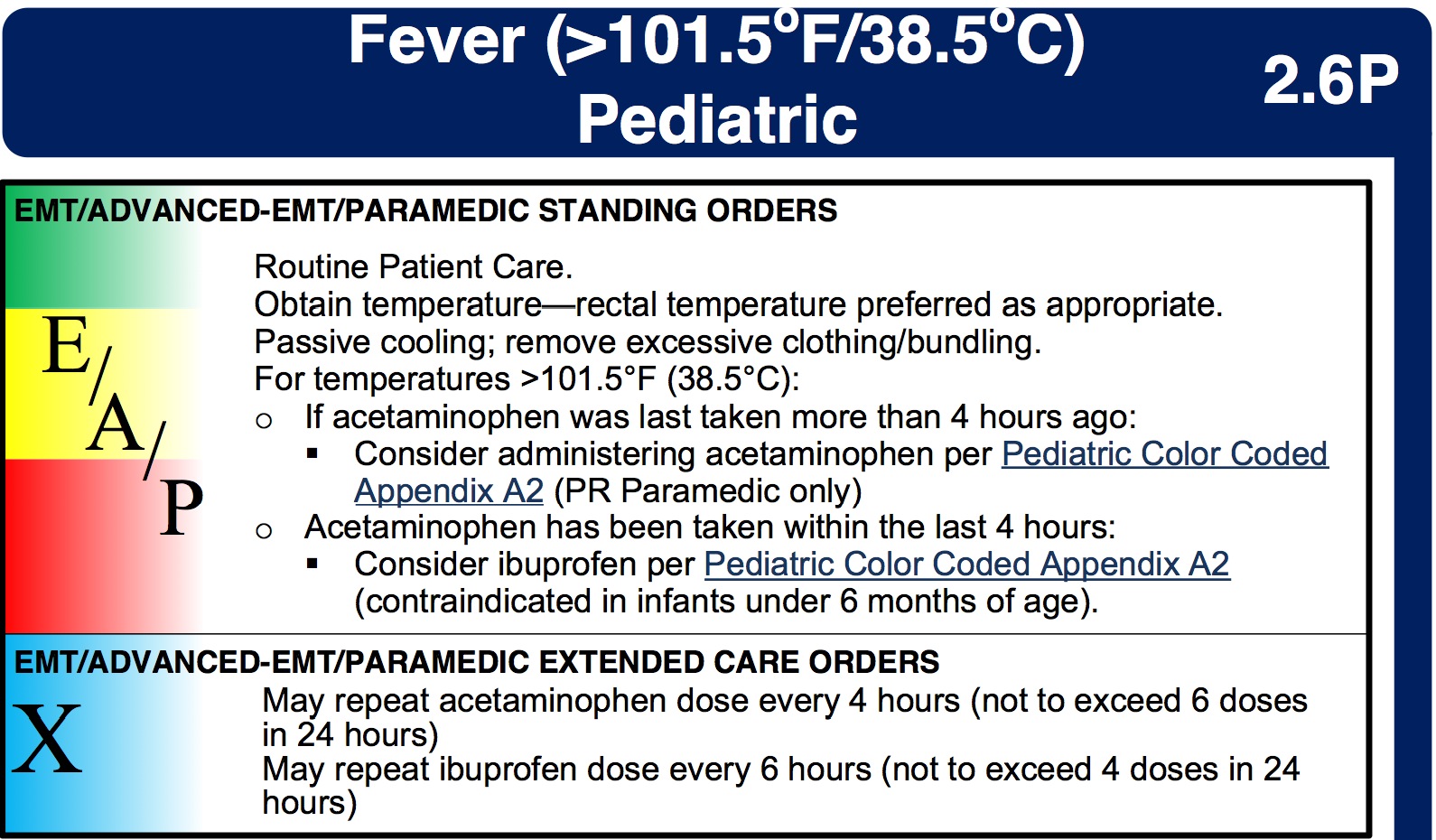
Treating mild discomfort is a great idea, since not all pain needs morphine. But protocols, in general, only mention a number (temperature) as a trigger for antipyretic use, and most protocols can’t even agree on which number that should be. You can find examples of fever "triggers" for antipyretic use at 100°, 100.2°, 100.4°, or even 101.5°

For example, check out the New Hampshire state protocols:


It turns out there’s a good reason why there is no agreement on what temperature "needs" APAP - nobody knows! 

And not only is there no evidence saying what temperature elevation needs antipyretic therapy...


2. Fever isn’t dangerous!
While having a fever is unpleasant, there is no evidence that it is harmful. In fact, most experts agree that damage can’t occur until the temperature has been over 106° for a while, which is almost unheard of for an infectious cause.


(Hyperthermia - as in heat stroke - is a entirely different matter, and brain damage can occur quickly, even below 106°. But no one talks about giving Tylenol to a kid that’s been locked up in a car during summer.)


The American Academy of Pediatrics makes it pretty clear 
There is no evidence that reducing fever reduces morbidity or mortality from a febrile illness.
Yeah, we should treat pneumonia or meningitis with antibiotics (or heatstroke with ice), but there is no benefit to Tylenol besides feeling a little better.


3. It won’t stop a febrile seizure, or keep it from happening again.
Yes, febrile seizures are often unsettling to parents, but they are essentially harmless. Per the experts:
There is a theoretical risk of a child dying during a simple febrile seizure as a result of documented injury, aspiration, or cardiac arrhythmia, but to the committee's knowledge, it has never been reported
But OK, they aren't, like, medically bad, sure. But why not quickly treat the fever in a kid who just seized, or who has a history of febrile seizures and just spiked a temp? Well, a number of studies have been done on the subject, and they all say the same thing - aggressive use of Tylenol or Advil does nothing to prevent the next febrile seizure. Phenobarbital or valium do prevent them, but they have significant side effects.

As the AAP guideline on febrile seizures notes that (my emphasis):

In situations in which parental anxiety associated with febrile seizures is severe, intermittent oral diazepam at the onset of febrile illness may be effective in preventing recurrence.

The paramedic’s job should be to reassure (when appropriate) the parents, and treat any mild discomfort associate with a fever. Wrestling a kid to give them Tylenol “to get their fever down” isn’t worth it, and likely doesn’t do much to help their mild discomfort. 

I'm also not sure how much the wrestling helps  treat the "severe parental anxiety!"


4. In adults with septic shock and fever, antipyretics could increase mortality
A recent issue of Chest (a journal for pulmonary/critical-care physicians) featured a spirited debate on whether septic patients with a fever should be cooled.


The only point on which everyone agreed was that antipyretics like Tylenol or ibuprofen weren’t useful, and could in fact make the situation worse. As the "pro-cooling" team in the debate conceded, 
Little evidence-based support exists for use of antipyretic medications to improve fever-associated morbidity and/or mortality.”


5. It may promote “fever phobia” in parents and medical providers.
By carrying the drug, and promoting its early use, EMS may play a role in driving "fever phobia." This is the name for the belief that many parents (and far too many doctors and nurses!) have, that fevers are very dangerous

As the expert pediatricians at the AAP put it, too many doctors and nurses worry about fever causing seizures, brain damage, or death. They then pass on these irrational concerns to the public. As they put it:
It is argued that by creating undue concern over these presumed risks of fever, for which there is no clearly established relationship, physicians are promoting an exaggerated desire in parents to achieve normothermia by aggressively treating fever in their children.
As a consequence, our medical offices, emergency departments, and EMS systems get many calls for a "kid with a fever," who doesn't otherwise look sick, wasting time and money, sometimes prompting unnecessary tests, and in general causing a whole bunch of bother.

The Bottom line
Giving Tylenol or Motrin, in accordance with your protocols, is fine. These are very safe drugs, and they do well at treating small aches and discomforts. But keep a realistic view of what you are using them for. And try to avoid spreading any medical myths!