As in Incident command...

IC established!
We'll have several different sections reporting in - recent research, local topics, or highlighting areas of the Sponsor Hospital Council of Greater Bridgeport protocols.

*** Keep in mind - this website does not replace your protocols, and these posts do not reflect SHCGB or Bridgeport Hospital policies. This is a place to discuss research, controversies, or discuss possible future protocols. When in doubt, check your current protocols through the official source.

Monday, March 31, 2014

You gave adensoine for THAT? (part 3)


To recap - the paramedic had a patient who was throwing off long segments of both narrow-complex tachycardias, and wide-complex tachycardias. An initial dose of adenosine managed to transiently establish a sinus rhythm.

Sinus rhythm for 3 whole beats! *Pumps fist in air*
So what was converted; SVT or VT?
It's tempting to think that, beacause it was converted by adenosine, it must have been a SVT with aberrant conduction. A few things suggest that this was, instead, true VT.

Playing the odds...
First, a wide-complex rhythm in an older patient is far more likely to be VT than SVT - if you're betting, that's where yo should put your money. 

Your instructor was right - axis is important!
Second, you could be tempted to call this a left bundle branch block, but the axis is unusual. A LBBB usually points off towards the left.
Note the large R waves in I and aVL (Source)
Our patient, on the other hand, shows an axis oriented a bit to the right.

Note the large R waves in II, III, and aVF
Fusion beats
Third, the patient keeps kicking out fusion beats, or QRS complexes that show features of both a supraventricular beat, and a simultaneous ventricular beat. They usually look like an "average" of a PAC and a PVC. Here's an example from Life in the Fast Lane:

Not wide, not narrow, just ... average.
(source)
 When we look at the initial rhythm strip we see a bunch of sorta wide/sorta narrow beats.


Another ECG, done in the ED, also shows multiple fusion beats, indicated by the arrows.


Such a finding strongly suggests that this patient had ventricular tachycardia that was converted by adenosine. Crazy, right?

Well, it turns out that not everything that converts with adenosine is SVT!  One infrequent kind of VT can convert with adenosine - right ventricular outflow tachycardia.

RVOT
A fairly uncommon kind of VT is know as RVOT, named for the location of the problem. It basically looks like a LBBB, but with an inferior, rather than a left-oriented axis. A great example comes courtesy of Dr. Ken Grauer. Compare it with the initial 12-lead we have.


RVOT - from Dr Gauer's collection.
I'm not going to go on further about this rhythm, since it's pretty uncommon, but if you want to know more go check out Dr Grauer's blog.

(I'll note again that my cardiology education started when I read the 1993 edition of his ACLS textbook. He has a 2014 update, available on a variety of e-readers. Buy it!)


Uh, so there's this rare RVOT thing. Why should I care?

As I mentioned in Part 2, there are two important things to know about giving adenosine for a WCT:
  1. Adenosine is relatively safe in regular, monomorphic WCT.
  2. However, it can convert certain types of VT.
Since the publication of the 2010 ACLS Guidelines, a large number of EMS agencies have adopted adenosine as the first agent to administer in the treatment of a stable, regular, and monomorphic wide-complex tachycardia. I don't have any hard numbers on how common this protocol is, but instead of a study, I can give you a collage! 

I makes it for u.
Despite the popularity of this protocol, many clinicians have reservations about the wisdom
of this approach, since there are a number of potential pitfalls. One of the big ones would be to assume that adenosine is a reliable test for supraventricular rhythms. Keep in mind that he ACLS guidelines only state that "adenosine is relatively safe for both treatment and diagnosis."  

Safe, not accurate!

The Bottom Line
The SHCGB protocols allow for the use adenosine when the etiology of a WCT isn't clear. Keep in mind that, even if adenosine is successful, the etiology may still be unclear!

Friday, March 28, 2014

You gave adenosine for THAT?! (part 2)

In a prior post, I looked at whether you could give adenosine to a patient with a history of WPW (see "Can you give adenosine to a patient with WPW"). The answer was "Yes, but..."

I want to look at another adenosine issue today - can (or should) you give adenosine to a patient with a wide-complex tachycardia (WCT)?  

Spoiler: The answer to this questions is...


Or, more specifically:
  1. Adenosine is relatively safe in regular, monomorphic WCT.
  2. However, it can convert certain types of VT.
A case of WCT treated with adenosine by EMS
Our paramedic was just "minding his own business" when he was called for a patient with palpitations. He was an older person, with no history of any cardiac problems, and was hemodynamically stable. His rhythm strip, however, looked like:

Wut.
Okay, that's a data-rich ECG!  Taking a closer look at two different segments, we see evidence of both a regular monomorphic WCT...


So it's VT, right?
... as well as a regular narrow-complex tachycardia.

Tell me if you see P waves. I didn't.

VT with episodes of PSVT?
The full 12-lead ECG looked wide and scarey:


So, what to do?
Our intrepid medic decided that adenosine would be appropriate, and gave a slug, right as the patient was going through a spell of WCT.

At first it seemed to work ....

... aaaand right back into the WCT, after a brief period of apparent sinus rhythm.

Wait, what the heck - the adenosine converted a VT? Or was it aberrant SVT? What should the next drug be? How much does the response to adenosine change our impression?

To be continued...
Tell me what you think, and I'll be back with the follow-up, as well as how lessons from this case should affect your assessment and treatment in the field.


Monday, March 3, 2014

"We had a LUCAS save!" - No, you didn't.

I don't get it.

More and more, I'm seeing Facebook posts, newspaper articles, and personal testimony that excitedly describe a "LUCAS save." That is, a successful resuscitation is credited to the use of a mechanical compression device made by Physio-Control. For example:

"Saves man's life!"
Source
"More residents survived thanks to LUCAS!"
Source
"Life-saving CPR technology!"


Source

"Life-saving technology!" "Saves local man!" "Thanks to LUCAS!" Why hasn't this news of Lazarus-like success swept the country? Why are we still doing CPR with our hands?


Doing CPR with our muscles... like a sucker!
 Well, there is one teensy fact that the press releases leave out...

The LUCAS doesn't save lives.
And no, I don't mean this in the clever "guns don't kill people..." sense. 
I mean this in the "proven by science" sense.

Source
This study, published in January, describes the use of the LUCAS in out-of-hospital cardiac arrest. 

 - Methods
The study looked at patients who had a cardiac arrest treated by EMS. They enrolled adults, who had suffered a non-traumatic arrest, and were neither too small, nor too large, to fit in the LUCAS. They randomized patients to either get manual CPR according to 2005 European ACLS guidelines, or to get chest compressions delivered by a LUCAS device.


The teams were well-trained - not only was there initial preparation for the teams with both usual and mechanical techniques, but team members had twice-yearly re-training, as well as random "spot checks" of individual participants using a manikin. Pretty rigorous!

The primary outcome was maintaining survival for 4 hours after ROSC. You can quibble that this isn't as important as, say, neurologically-intact discharge from the hospital, but it's a reasonable goal, and likely easier to achieve.

 - Results
This should have been a slam-dunk for the machine. Mechanical CPR is consistently high-quality, does not fatigue, and frees up EMS workers for other tasks. One more bonus for the machine - the protocol called for defibrillations to be given during the mechanical compressions, something that humans are not usually able to do! In theory, this elimination of the peri-shock pause should have increased survival in the LUCAS-treated patients.


LINC trial protocol

However, after 2500 patients were enrolled, they found squat for differences between manual CPR and the LUCAS. Nothing. No matter what outcome you picked, there was no advantage to using the LUCAS. None.


LINC trial results
 - Interpretation
So that's the end of the LUCAS for routine management of cardiac arrest by EMS, right? We did the research, it was negative, and we took the expensive machines off the rigs. The EMS services that haven't bought them have expressed relief that they didn't lay out the cheddar.

"But the LUCAS..."
But regardless of these completely negative results, people are protesting. They point out that, yeah, maybe this study didn't show a difference. "But the LUCAS..., " they point out...

  • "...delivers better CPR!" 
  • "...can shock during CPR!"
  • "...can do better CPR during transport!"
  • "...doesn't get tired!"
Despite all that, which is likely true, no difference was found in a high-quality trial where the researchers has every opportunity to demonstrate these . This is how clinical research goes - the slaying of appealing theories by means of ugly facts.
The graph is explained HERE, if you're into that sort of thing.

Don't give credit to a piece of plastic!
A recent article over at JEMS describes a successful cardiac arrest resuscitation. The authors write about the myriad contributing factors:
The integrated training between EMS responders and the CPR/AED-equipped police officers; the multilayered, coordinated response and resuscitation effort by police and EMS familiar with the pit-crew approach to resuscitation and use of a mechanical CPR device; and the rapid response and time-to-care by the rescuers—particularly at such a large gathering—were all key factors in this successful resuscitation.
But the authors then go on to emphasize in the last paragraph that the LUCAS "was clearly a part of this successful resuscitation," and that "they’d never seen this type of response in all of their years of managing cardiac arrest cases." 

In other words; "We did okay, but we're pretty sure that this inanimate object should get the lion's share of the glory." 

You know, I think I've seen this before...


"Simpsons already did it!"

The Bottom Line: 
You know what saves lives? 

You

You, and your well-trained team, utilizing the proven techniques that save lives. Believe me, if the LUCAS was able to generate these sorts of results...
 Source
... you would have heard about it by now!

(For another analysis of this trial, plus some interesting comments, read the post Man vs Machine: A CPR Battle to the... over at Ryan Radecki's excellent blog.)

Tuesday, February 18, 2014

Sudden Cardiac Death Among Firefighters ≤45 Years of Age

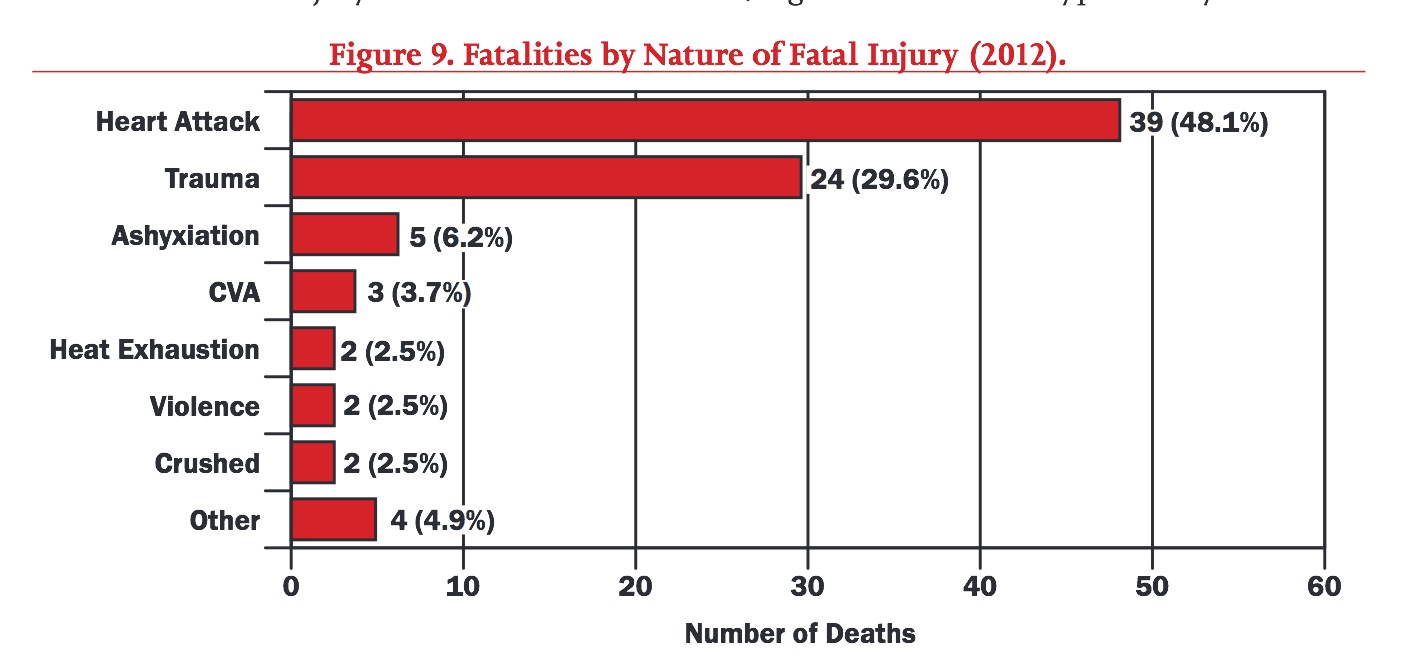
I want to talk about a new study that looks at heart attacks in younger firefighters, so no jokes or funny picture today. It’s hard to come up with a humorous spin for a graph like this: 
From a 2012 FEMA report
The chart above comes from the 2012 USFA report of firefighter fatalities, and it’s shocking. Over half the fatalities in that year had nothing to do with burns, entrapment, falls from ladders, or other traumatic dangers. Instead, MI and stroke, in general, were the biggest danger firefighters faced. 
Now, this is partly a function of age, but 15% of the deaths from MI were in firefighters younger than 45 years old. A recent study focused on this group, and found some surprising results.
The Study
The authors of Sudden Cardiac Death Among Firefighters ≤45 Years of Age in the United States wanted to take a closer look at these younger firefighters who died of cardiac causes, and see if there were any risk factors that could explain those deaths. 


To do this, they used the database maintained by NIOSH (http://www.cdc.gov/niosh/fire/) to find all cases of firefighters < 45 years of age who had a sudden cardiac death. They looked at the period from 1996 to 2012, and examined autopsies and other reports.
They then selected a bunch of age-matched, healthy, “occupationally active” control firefighters to compare them to. Additionally, they looked at noncardiac traumatic fatalities (deaths due to blunt trauma, burns, or asphyxiation) to serve as a second comparison group.

1. The FFs with sudden cardiac death 
They found 87 FFs under the age of 45 who had a sudden cardiac death during that time. 

A few results stand out:
  • Almost all were men.
  • Over 1/4 of them smoked 
  • Almost 2/3 (63%) of them had a BMI ≥ 30
  • Over 1/4 of them had a BMI over 35
  • Over 1/2 had evidence of both cardiac disease and cardiomegaly
At first glance, it looks like these firefighters had much worse health than the general public. But maybe this is due to the unique stresses of the job. For example, disruption of normal sleep patterns could encourage sleep apnea, leading to hypertension and obesity.

So in order to clarify the issue, they compared the FFs who had sudden cardiac death with the people most like them - other firefighters!

2. Compared with occupationally active FFs
When they compared these FFs to the occupationally active" FFs, however, they found concerning results, suggesting that the FFs who had cardiac arrests were indeed unhealthier than their own peers.


Obesity, smoking, and hypertension were significant predictors of cardiac death while at work. Not unexpectedly, a history of cardiac problems was a huge risk factor as well.

3. Compared with FFs who had a traumatic death
When they then compared the FFs who died from sudden cardiac death to those that had a traumatic death, they found significant difference in both age, and in the size of their hearts. FFs who suffered a cardiac death had higher rates of cardiomegaly, or enlarged hearts, suggesting that they had had longstanding problems with hypertension or obesity (or both).


So what do we do with these results?
First off, prevention (i.e. lifestyle) trumps everything. Quitting smoking, keeping a healthy weight, and maintaining a vigorous exercise routine, amongst other things, may have gone a long way towards preventing many of these deaths. Although firefighting presents many unique challenges to staying healthy (e.g. schedules that disrupt sleep patterns, exposure to heat stress), the comparisons to healthy FFs, as well as those who died from trauma, show that smoking and hypertension play a huge role in raising the risk of cardiac death.

Second, we need to prepare for cardiac arrest in firefighters. The unique nature of the fireground, as well as the obstacles that the clothing and equipment present, mean that departments need to practice their response to a "fallen" firefighter, aiming to start CPR and assess for a shockable rhythm as soon as possible. This requires special procedures, teamwork and practice. Watch these guys from Hilton Head FD run through a drill.


Be safe, and take care of your heart!

Sunday, February 9, 2014

Can you give adenosine to a patient with WPW?

Maybe you can answer the question in the title completely and confidently. If so, feel free to skip this post, and go on to some more entertaining corner of the web. However, it seems to me that many emergency providers are unsure about how to approach a confusing issue with adenosine:
Can (or should) you give adenosine to a patient with known or suspected WPW?
Spoiler: The answer to this questions is

More specifically:
  1. Adenosine is safe and effective for terminating SVT (narrow or wide) caused by WPW, but...
  2. Giving adenosine for WPW with atrial fibrillation, however, can be lethal.
One recent case that was treated in the field illustrates principle #1. Fortunately, no local medics have provided us with a demonstration of principle #2!

(As always - Follow your local protocols for WPW and arrhythmias!)

Can you give adenosine to a patient with WPW?
Case report:
This is best illustrated with a case! Paramedic Harvey had a patient with palpitations, tachycardia, and a good BP, and she obtained the following ECG.


A narrow-complex, regular tachycardia in a stable patient? Looks like an SVT!  Medic Harvey decided, appropriately, to bust out the adenosine.

A rapid bolus of 6 mg broke the tachycardia, and restored NSR on the monitor, but the follow-up 12-lead looked a little odd:


A few minutes later a second post-conversion ECG was obtained.


Huh. You know, that sort of looks like...

It was at this point that the patient told Heather 
"I probably should have told you that I have WPW."

Wait, what?!
Oooooo.... Isn't WPW supposed to be a dangerous rhythm, where you can send the the patient into VF just by thinking about adenosine? Holy cow, did the medic just get lucky, or what?

Brief Review of WPW
Let me go over the pathophysiology briefly. 
(For a fuller description, check out a great new e-book by Ken Grauer, entitled ACLS - 2013 - ePub, for more education on WPW and other topics in ECG interpretation and ACLS.)

The 1993 edition was pure gold when I was in paramedic school.
It's only gotten better - seriously, download this now!
There are 2 common causes of a regular narrow-complex tachycardia, or SVT
  • The most common is AV nodal reentrant tachycardia (AVNRT), which involves a "loop" of electrical current that is confined within the AV node. These are narrow unless aberrant conduction occurs.
  • By contrast, AV reentrant tachycardia (AVRT), involves a "short circuit," or accessory pathway, between the atria and the ventricles that bypasses the AV node. During normal sinus rhythm, the ECG will often demonstrate signs of "pre-excitation" of the ventricles; a short PR, a delta wave, and a wide QRS.
Grauer K: ACLS-2013-ePub, KG/EKG Press (available in kindle/ibooks/nook/kobo)
When an episode of AVRT (aka SVT) is triggered, however, the QRS will usually be narrow, and the delta wave will disappear (as seen in Panel A below). As noted in Panel B, however, in a rare minority of patients the circuit of conduction will be "backwards," and produce a wide QRS.

Grauer K: ACLS-2013-ePub, KG/EKG Press (available in kindle/ibooks/nook/kobo)
So, there are some important differences between the two main causes of SVT (AVNRT and AVRT). It's important to emphasize, though, that...

AVNRT and AVRT have 3 important things in common:
  • Both rely on the AV node to complete the "loop" of electrical current that generates the tachycardia;
  • In both, the sinus node is generating normal, controlled signals; i.e., 60 - 100 beats per minute.; and 
  • Adenosine will terminate the reentrant thythm in both by shutting down the AV node.
In AVNRT, adenosine effectively "cuts" all electrical connections between the atria and ventricles (temporarily!). In AVRT/WPW, however, the bypass tract is unaffected by the drug, and is still capable of conducting electrical signals to the ventricles. This could potentially lead to sinus impulses being conducted anterograde down the AP, producing wide, "aberrant," QRS complexes, but at a controlled rate (i.e. 60-100 bpm).

WPW with AF can be lethal if treated with adenosine
This is entirely different when the patient has WPW and atrial fibrillation. Remember that, in AF, the atria are firing off at 300 - 400 times a minute, not the controlled rate of 60-100 that the SA node generates. 

So, if these all of these electrical impulses are transmitted to the ventricles through the bypass tract, the myocardium will freak out. Like this.

Source: Shah 2001

WPW without AF is safe to treat with adenosine
We probably don't need to worry*, however, about giving adenosine in patients with WPW, but without AF. There's a few reasons why.

1) First off all, about a third of the SVTs that you have given adenosine to in the past were actually caused by AVRT/WPW, just based on the epidemiology. Since practically none of these developed VF (right?), this is apparently a very safe practice.

2) Second, there was a concern in the past that a certain percentage of wide-complex tachycardia were actually WPW with antidromic conduction, and so the advice was to avoid adenosine. The rationale was that since the bypass tract was capable of retrograde conduction, shutting down the AV node could "expose" the ventricles to potentially unregulated pacing. However studies such as this one have convinced a number of people, including the AHA, that adenosine is pretty safe in anyone with a (regular!) wide-complex tachycardia. 

3) Third, many cardiology experts believe that adenosine is safe in regular WCTs. The authors of a 1991 study found it to be quite safe in this setting, and concluded that 
"Adenosine may cause acceleration of preexcited atrial arrhythmias, but these effects are transient and should not discourage the use of adenosine as a diagnostic agent in broad complex, regular tachycardias of uncertain origin."
Dr. Stephen Smith, of Dr Smith's ECG Blog fame, believes that we don't even need clinical evidence to prove that adenosine is safe in regular tachycardias, wide or narrow, in a person with a history of WPW. A fundamental understanding of cardiac physiology is enough to sh0w this:
"Anyone who knows what AVRT is, and what it is that electrical circuits do, knows that it is safe to give adenosine. If you ask an electrophysiologist for an article on this, they will say 'There are no articles, because this is so obvious that it needs no proof.'
[A]denosine is safe in VT. One need not prove that it is safe in AVRT ."

The Bottom Line
So it turns out that adenosine was quite safe with Harvey's patient, as well as effective. This probably wasn't a fluke!

Although many medics have been taught that Wolff-Parkinson-White (WPW) and adenosine are a dangerous combination, this isn't often the case. On the contrary - it seems likely that medics and physicians have frequently given adenosine to patients with undiagnosed WPW, without apparent ill effects. 

Furthermore, the recent emphasis on giving adenosine for regular wide-complex tachycardias of uncertain etiology makes it even more likely that YOU will give adenosine to someone with undiagnosed WPW. A small number of those WCTs represent WPW with antidromic conduction, but adenosine administration has not been documented to cause any problems to date.

So, follow your local protocols for arrhythmias and WPW, but keep in mind the available evidence, as well as expert opinion, suggests that adenosine is safe in most cases.
__________________________________
* Okay, there are a few, totally theoretic, reasons to worry about giving adenosine to patients with WPW. I mention these only out of a sense of completeness. 

First of all, adenosine is not totally benign, and it has been shown to induce atrial fibrillation in a number of case reports. Although the half-life is fairly short, it's conceivable that adenosine could first trigger AF in a patient with a history of WPW, and that the AF could then immediately degenerate into VF. One case report describes how a young woman with SVT developed AF after performing a Valsalva maneuver. Adenosine was then given, and the rhythm degenerated into a pulseless irregular WCT. Cardioversion restored a pulse and sinus conduction.

Second, although there are no case reports that I know of have shown an antidromic WPW tachycardia deteriorating after adenosine administration, this is a rare rhythm, and even a moderate relative risk of adverse effects from adenosine would produce a small absolute number of complications. For example, the study by Maril (that demonstrated the safety of using adenosine in WCTs) only enrolled 2 patients with a history of WPW. One of those patients was determined to have been having a ventricular (non-accessory pathway dependent-) rhythm upon enrollment. It's hard to determine the absolute safety of a drug for such a rare rhythm. 

Nonetheless, even a "worst-case scenario" suggests that an adverse event would be very rare.

Monday, January 13, 2014

Pediatric Anaphylaxis: Medication errors by EMS

You are called for a 5-year-old child with trouble breathing. 

The mother states the child has had 1 hour of progressive respiratory distress after being stung by a bee. The initial vitals are BP 76/40, P 120, R 45, and SpO 91% on room air. The patient is sitting upright, speaking in short sentences, and has audible wheezing. The physical exam reveals hives over the chest and arms.  If you don't act in 2 minutes, your patient will decompensate. What do you do?

(By the way, this is a HIPAA-compliant picture of your patient:)


Yup, it’s a replicant, and just like Roy Batty, he was programmed to die in this EMS simulation study performed in Michigan. 

Unlike Roy Batty, however, this replicant will live if he is given epinephrine in time!

"I've seen things you people wouldn't believe...  And I need some epi!"

The authors used a high-fidelity simulation manikin, in a well-equipped simulation center, as well as the scenario described above. They allowed the EMS crews to use their own medication and equipment, but they all had to follow the state EMS protocol for pediatric anaphylaxis. 

Michigan EMS protocols
 If the crews gave the right medications and interventions, the kid got better. If not....

So what happened? 

Before I answer that, let me point out that the EMTs and medics volunteered for this study. This suggests that these folks were motivated enough to participate in research, aware they were going to observed, and fairly confidant in their knowledge and skills. In other words, probably some good, smart people.

So, it's all the more distressing what the study found.

1. Three out of 62 crews (5%) did not give epi 
For true anaphylaxis, epinephrine is the required treatment, with essentially no contraindications. 


2. Epi was often given by the wrong route. 
The protocol spelled out that epinephrine should be given IM, in line with several national and international guidelines. Despite this, only 37 out of 59 (63%) crews gave epinephrine IM. The authors were generous, and allowed SQ as an acceptable route, but this is an outdated practice. 

3. An epi dose of > 1 mg was given by 20% of crews. 
‘Nuff said about that... 

4. Epi was given intravenously by 15% of crews 
Although IV epi is listed in the protocol, even "low" doses of IV bolus epi can cause badness. With that in mind, the protocol allowed for IV epinephrine only “in cases of profound anaphylactic shock (near cardiac arrest).” 

Because the patient was initially sitting upright, speaking, and perfusing, IV epi was considered a major error.

5. Less than half of the crews gave epi by the right dose and route. 
As shown in this table:


So why did this happen?
It's hard to manage a rare medical event, using a drug that is available in multiple concentrations, and can be given by multiple routes, but must be dosed accurately by weight.

And as I said before, these were engaged and motivated EMS providers. Furthermore, the errors that they committed have been demonstrated to occur in a number of prior studies and case reports, involving a wide range of medical personnel.

In other words, you can’t respond to this study by saying “Well, our guys would never screw up like this!” Or by saying “We’ve been doing it this way for years without a problem.” This study should force all of us to reevaluate how we teach, protocolize, and practice treatment of anaphylaxis.

If you have the patience, download the author’s summary (the picture below) of the types of errors that were committed, and the rationale of the medics who committed them. Very informative!