One development in EMS in the past few years has been the push in many states to get prehospital providers to carry and administer steroids to people with various forms of adrenal insufficiency. Unlike cardiac arrest, intubation, or cervical spine injury, there hasn't been a great deal of talk in the EMS blogs about this subject, so I was hoping to address that deficit!
First off, why should I care about adrenal insufficiency?
Well, one answer is that some one is going to make you care. Most likely, that someone will be the CARES Foundation. This group was started by the parents of a child with congenital adrenal hyperplasia (CAH) (relax if you aren't familiar with CAH - we don't see it very often in the ED!). Back in 2009, they started focusing on the role of EMS in treating children with CAH. If we take a look at this map of the United States that shows which states have EMS protocols for treating CAH crises:

The more astute readers will say - "Hey! Out of every 16,000 live births, only one will have classic CAH! That doesn't sound too common." Well, yeah, you're right. On the other hand, there are a lot of people out there in the world with adrenal insufficiency, and they can get into the same problems.
Sooo... What is CAH, adrenal insufficiency, and stuff like that?
Let me explain the two forms of adrenal insufficiency you'll deal with. This is a crazy-deep topic, but there will be basically two kinds of steroid problems you'll see.
- Little kids with a known diagnosis of CAH, and,
- Adults with a diagnosis of adrenal insufficiency who tell you that.


- The hypothalamus makes CRH.
- When some of that CRH drifts by the pituitary, it makes some ACTH.
- In turn, the ACTH triggers the production of cortisol from the adrenal gland.
- Eventually, the elevated cortisol levels shut down (temporarily) the production of CRH and ACTH.
- When the cortisol levels settle down, the process is ready to go again!
Adults can a variety of different problems with their steroid-making process: Maybe the have Addison's disease, like a former president did. Maybe their adrenal glands eroded during an infection. Maybe they're taking mondo amounts of steroids to prevent transplant rejection, and their body has "forgotten" how to make it's own steroids now. These folks also are on chronic steroids.
 |
| Nope. Try again. |
Okay, it sounds like we have the problem solved then!
Er, almost. The problem is that the body regulates the ebb and flow of cortisol over a wide range of levels. For example, your morning level is about 10 times higher than your midnight level.
When you get sick, no one is quite clear what the right level should be. When kids get sick, parents are taught that their daily dose of pills should be significantly increased, and are given detailed instructions (PDF download) about when to, say, double or triple their usual dose.If things get real bad, they have a emergency steroid injection kit, and the parents have practiced how to draw up and give the shot.
Good, the parents are all over it. What's left for us?
Well, even fairly small kids can't hang around their parents all day, every day. They may get stuck with. well-meaning relatives, day-care, or even a lowly babysitter. While the parents may be up to speed on the the when and how of injected steroids, it's asking a bit much to expect 16 year-old sitter to do that too.
 |
| Not what she signed up for. |
Naturally, you know all about assessing acute adrenal insufficiency, right?
What do adrenal-insufficient people in a crisis look like?
First off, these people already have a history of chronic adrenal insufficiency. That begs the important question: What exam finding indicates a patient has chronic adrenal insufficiency?
|
| Answer |
Next part in assessment is figuring out what else is gong on. Something had to trigger an episode of acute insufficiency; there are diverse causes, but all of them stress the body in some way. The general causes, though, are: Stopped steroids abruptly, fever/infection, a large trauma, vomiting. The New Hampshire protocols, for instance describe which patients to treat with specific therapy:

Patients will look shaky, gray, sweaty. The may be hypotensive and hypoglycemic as well.
The paramedic should look at the precipitating events, and treat those, whether it's a trauma, an asthma attack, a burn, a bad episode of gastroenteritis, or pneumonia. Second, they should address the symptoms of the episode: Zofran for vomiting, dextrose if they're hypoglycemic, IV fluids for hypotension. An EKG could show signs of hyperkalemia, and you should be ready to ask med control for calcium chloride.This is all stuff you should be doing now.
The specifc therapy for acute adrenal insufficiency is hydrocortisone, or Solu-Cortef:
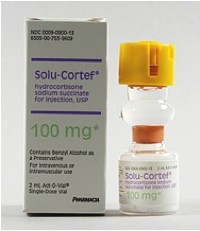 |
| Adult dose = 1 box, IM, IV, or IO. |
So, be ready for the change when it comes!

Wow! Well written post and very accurate. As someone with Addison's Disease, I really appreciate such a great post on our behalf!
ReplyDeleteDusty Hardman
www.addisonssupport.blogspot.com
+1
ReplyDeleteI am newly adrenal insuffecient due to kidney cancer and I also appreciate the post.
The medics around here have all been absolutely baffled about this one. Someone needs to do an in-service.
ReplyDeleteThank you for writing this. I have Addison's and wish the medical community were as well informed as you.
ReplyDeleteThe parents, or some parents, pressured the state to add Solu Medrol to the protocols for Adrenal Insufficiency. Not to be used for Asthma, not to be used for Anaphylaxis. Only to be used for a CAH crisis.
ReplyDeleteOf which there has been exactly one in this state in recorded EMS history.
I used Solu Medrol slightly out of protocol for an acute Anaphylaxis and didn't get in trouble for it other than to be told not to do it again.
It would make much more sense add acute Asthma and Anaphylaxis to the protocol because we wouldn't end up tossing expired medications time after time because we don't see CAH crises in the field.
For that, I credit well educated and involved parents and family members. They know how to treat the problem and thus we don't get those calls.
Once again bureaucrats, pressured by "advocates" make a rule based on an exception. No wonder EMS never gets anywhere.
This is soooo appreciated! No one knows about adrenal insufficiency and certainly not CAH. My son is an adult with the disease and has even been refused treatment for it in the ER.
ReplyDeleteFocus on co-pays, paying out points of confinement, and deductible sums around every segment every medical coverage you're looking at. The objective will be to do what on earth is called "examination perusing. "surgeons in Virginia
ReplyDeleteAm Lucy Morgan from Atlanta Georgia i was suffering from genital herpes, oral herpes, shingles. Before I came in contact with dr. Kham It is no longer news that the Acquired immune deficiency syndrome Herpes Virus is increasing by the day, The fear is that many people living with the sickness are scared of saying it because of the stigma that comes along with it.I am bold enough among many others to state that there is now a potent cure to this sickness but many are unaware of it.I discovered that I was infected with the virus 3 months ago, after a medical check-up. My doctor told me and I was shocked, confused and felt like my world had crumbled. I was dying slowly due to the announcement of my medical practitioner but he assured me that I could live a normal life if I took my medications, In a bid to look for a lasting solution to my predicament, I sought for solutions from the voodoo world. I went online and searched for every powerful trado-medical practitioner that I could severe, because I heard that the African Voodoo Priests had a cure for Herpes syndrome. It was after a little time searching the web that I came across one Dr. Kham website who offered to help me, He gave me some steps to follow and I meticulously carried out all his instructions. Two days ago to be precise, I went back to the hospital to conduct another test and to my amazement, the results showed that " I am NEGATIVE" You can free yourself of this Herpes virus by consulting this great African Voodoo Priest via this EMAIL dr.khamcaregiver@gmail.com or dr.khamcaregiver@outlook.com] WHATSAPP NUMBER +2348159922297, You can Also Visit his website to know more about him at > https://drkhamherbalhealingcenter.wordpress.com/
ReplyDeleteHE CONFIDENTLY TOLD ME HE CAN ALSO SOLVE THE FOLLOWING PROBLEMS WITH ANY DELAY IN TIME
PREGNANCY spell
EPILEPSY cure spell
GENPILENCI
HIV AIDS.
PREGNANCY
DIABETICS
STROKE.
EXPANDS OF PENIS BREAST
H.P.V TYPE 1 TYPE 2 TYPE 3 AND TYPE 4. TYPE 5.
HUMAN PAPILLOMAVIRUS
HERPES.
SYPHILIS.
CANCER.
HEPATITIS A B and C.
HIGH BLOOD PRESSURES AND BODY BOILS.
Hello everyone. I want to share my amazing experience with the great spell caster Dr Mark my husband was cheating on me and when I found out we had a fight which lead him filling for a divorce I cried and fell sick when I was searching about love quotes online I saw people talking about Dr Mark and his great work whose case was similar to mine they left his contact info I contacted Dr Mark and he told me not to worry that after 24 hours he will cancel the divorce and my husband will be back to me after I did everything he asked me to do to my greatest surprise the next day evening it was my husband he knelt down begging me to accept him back, thank you once again Dr Mark you are indeed a blessing to me he can also help you. contact Dr Mark through his email address on: blessedlovetemple@gmail.com
ReplyDeleteI really want to thank Dr Emu for saving my marriage. My wife really treated me badly and left home for almost 3 month this got me sick and confused. Then I told my friend about how my wife has changed towards me. Then she told me to contact Dr Emu that he will help me bring back my wife and change her back to a good woman. I never believed in all this but I gave it a try. Dr Emu casted a spell of return of love on her, and my wife came back home for forgiveness and today we are happy again. If you are going through any relationship stress or you want back your Ex or Divorce husband you can contact his whatsapp +2347012841542 or email emutemple@gmail.com website: Https://emutemple.wordpress.com/ Https://web.facebook.com/Emu-Temple-104891335203341
ReplyDelete
ReplyDeleteI was diagnosed with COPD four years ago and struggled with worsening symptoms despite using inhalers and medications. Last year, I tried a herbal treatment from NaturePath Herbal Clinic, and to my surprise, it made a huge difference. My breathing improved, the coughing eased, and my energy came back. I feel better than I have in years. If you're dealing with COPD, I highly recommend checking them out: www.naturepathherbalclinic.com.